Manual or Instrument: The Two Ways We Adjust in New Castle
Two different approaches to the same goal: getting motion back into a joint that has lost it.
September 21, 2026 · 4 min read
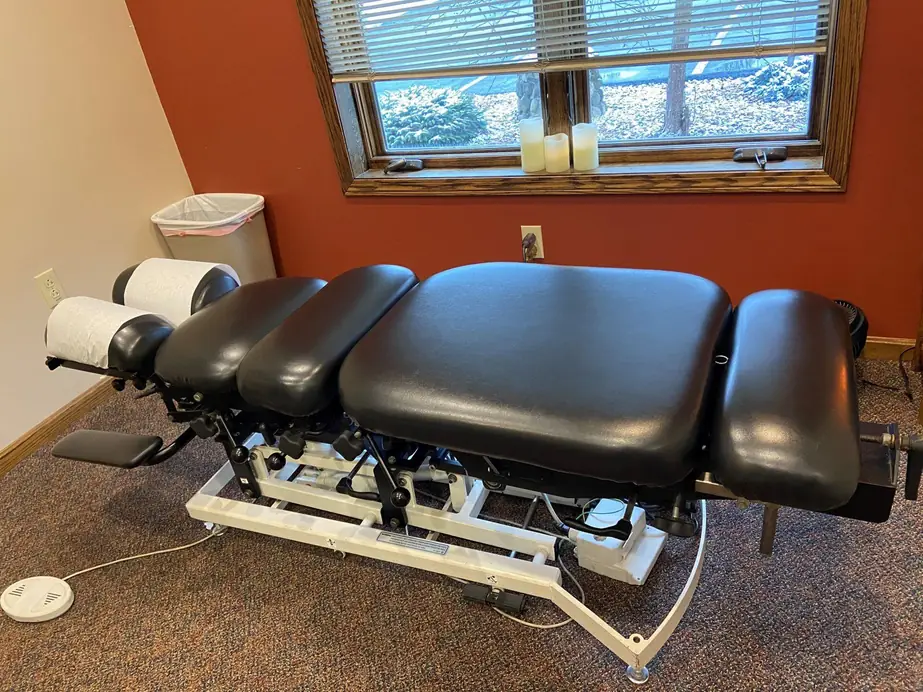
If you've never been adjusted before, or it's been years since your last visit, you might picture one thing: a quick twist and a pop. That's part of the picture, but it's not the whole one. At Mahle Chiropractic here in New Castle, we use two different approaches depending on what a person's body needs that day, and neither one is the "real" one. They're just different tools for the same job, putting motion back into a joint that isn't moving the way it should.
Manual adjusting
Manual adjustments involve a small, directed force applied at the angle of the joint to improve the motion it has lost. This is what most people picture when they think of chiropractic care, hands doing the work directly. Within manual adjusting there are several distinct techniques, and which one gets used depends on the joint, the person, and what's comfortable for them. Gonstead, Diversified, Thompson Drop, Flexion-Distraction, Palmer Technique, Sacro-Occipital Technique, and Pelvic Blocking are all manual methods we use here. There's even a gentler cranial technique reserved for infants and children, since a newborn's spine obviously doesn't need the same force an adult's does.
One of the things patients tell us they appreciate is that manual adjusting isn't one-size-fits-all. A technique that works well for a stiff lower back isn't necessarily the one we'd reach for on a tight neck, and the doctor adjusting you will choose based on what they find during the visit.
Instrument style adjusting
The other option is instrument style, sometimes called computerized adjusting. Instead of force, it uses speed, a gentle vibration or tapping motion delivered through a handheld instrument rather than by hand. We use Sigma Instruments equipment for this, which does something manual adjusting can't: it tests the resistance and tightness of a joint first, then tells us exactly where to adjust. The computer analyzes the joint's movement before and after, so there's a measurable read on what changed.
Some people simply prefer the feel of it. It's quick, it's precise, and there's no twisting involved, which matters to patients who feel nervous about a more traditional adjustment or who just find the vibration more comfortable than a manual thrust.
How we decide which one to use
This isn't something we decide before you walk in. Dr. Mahle, Dr. Bowser, and Dr. Argiro each assess the joint in front of them and choose the approach that fits, and that can change from one visit to the next depending on how you're moving that day. If you have a preference, tell us. Plenty of patients do, and we're happy to work with it as long as it's appropriate for what we're addressing.
- Manual adjusting: hands-on, several named techniques, includes a gentle option for infants and children
- Instrument style: Sigma Instruments equipment, measures joint resistance before and after, no twisting involved
- The choice is made in the room, based on the joint and the person, not decided in advance
The range of areas we see
Patients come to us with all kinds of things going on: low back and leg pain, neck pain and headaches, mid back and rib pain, hip or knee pain, foot and ankle pain, shoulder pain, and elbow and wrist pain. Both manual and instrument style adjusting show up across that whole range. There isn't a rule that says one technique is only for the neck and another is only for the low back. What matters more is the individual joint in front of the doctor that day, how it's moving, and what feels right for that particular visit.
That flexibility is part of why we keep both approaches in the practice rather than picking one and standardizing on it. A single family might include a grandparent who prefers the precision of instrument style, a teenager who's fine with a manual adjustment, and an infant who needs the gentler cranial technique. Being able to move between them means we're not asking anyone to fit a method that doesn't suit them.
A locally owned practice since 2000
Mahle Chiropractic has been serving Lawrence County for over 20 years, and we're locally and family owned, not part of a large chain. We're also accredited with an A+ rating from the Better Business Bureau. We mention that here because trust matters as much as technique. Knowing who's adjusting you, and knowing they've built a practice in this community for two decades, is part of feeling comfortable on the table in the first place.
Whichever approach fits you, both are designed to do the same thing: get a joint that's lost motion moving again. If you're curious which one might suit you, or you just want to ask questions before your first visit, give us a call at (724) 656-9050. We see patients from New Castle and all across Lawrence County, and we're happy to talk it through before you ever get on the table.
Mahle Chiropractic, (724) 656-9050
Call (724) 656-9050More articles
What Actually Happens on Your First Visit to Mahle Chiropractic
From the front desk to your first adjustment, here's what a new patient can expect.
The Therapies We Use Alongside an Adjustment, Explained
An adjustment is often just one piece of the visit. Here's what the supporting therapies are for.